Hercule Poirot is Agatha Christie’s most famous sleuth, and the last one in Brook and Sarah’s series exploring her characters. In this episode they discuss his origins and why he continues to be popular.
Discussed and mentioned
The Mysterious Affair at Styles (1920) Agatha Christie
Curtain: Poirot’s Last Case (1975) Agatha Christie
At the Villa Rose (1910) A. E. W. Mason
Hickory Dickory Dock (1955) Agatha Christie
The Big Four (1927) Agatha Christie
Alibi (1928) Michael Morton
The Murder of Roger Ackroyd (1926) Agatha Christie
Agatha Christie’s Poirot (1989-2013) ITV Television Series
Related episodes
Christie’s Sleuths: Superintendent Battle (released January 23, 2024)
Agatha Christie Characters: Hastings (released March 11, 2025)
Agatha’s Characters: Ariadne Oliver (released November 12, 2024)
For more information
Instagram: @cluedinmystery
Contact us: hello@cluedinmystery.com
Music: Signs To Nowhere by Shane Ivers – www.silvermansound.com
Sign up for our newsletter: https://cluedinmystery.com/clued-in-chronicle/
Order Life or Delft by Brook and Sarah
Transcript
This transcript is generated by a computer and there may be some mis-spellings and strange punctuation. We try to catch these before posting, but some things slip through.
| Sarah | Welcome to Colluded Mystery. I’m Sarah. |
| Brook | And I’m Brook, and we both love mystery. |
| Sarah | Hi, Brook. |
| Brook | Hi, Sarah. Well, I can’t quite believe that it’s time to talk about the very last Agatha Christie sleuth. |
| Sarah | Yeah, we’ve worked our way through her different characters that serve as, as her primary sleuths, or supporting some of those other characters. And now it’s time to talk about Hercule Poirot. |
| Brook | That’s right. Today we’re taking on that mystery icon. And I do feel a little bittersweet about this because this is a project we’ve been working on for quite a while now. But we knew right from the start that we would save Hercule Poirot for last. It’s only right that the sleuth that started it all closes out our series. |
| Brook | So he appeared in 33 novels, two plays, and 51 short stories. And some of the numbers are a little skewed. Sometimes it’s 52 or 53 short stories. But between 1920 and 1975, Agatha Christie was publishing stories about this detective. |
| Brook | And like many of her other characters that we’ve covered before, Poirot’s biography is developed gradually across the stories. He’s introduced first as a former Belgian police officer who’s living in England as a refugee following the First World War. And this was in her very first book, The Mysterious Affair at Styles. |
| Brook | And then his final appearance is in Curtain: Poirot’s Last Case. And this was published in 1975. the last book that she published during her lifetime. |
| Brook | Poirot’s name was derived from two other fictional detectives of the time, Hercules Popeau from the author Marie Belloc Lowndes and Frank Howel Evans’ character, Monsieur Jules Poiret retired French police officer living in London. |
| Brook | And interestingly, Poiret was accompanied by Captain Harry Haven, so this is very similar to Captain Hastings. Another obvious influence is that of Arthur Conan Doyle and his Sherlock Holmes. |
| Brook | Poirot also bears a striking resemblance to A.E. Mason’s fictional detective Inspector Hanaud, and he first appeared in a 1910 novel entitled At the Villa Rose, and this predates Styles by 10 years. And I don’t know about you, Sarah, but I think this lineup is pure gold because it just gives us a biography of what Christie must have been reading in the years leading up to the beginning of her author career. |
| Brook | As far as his style of detection, he is extremely dignified, meticulous, and very vain. And although these traits sometimes serve as a comic device, it is also important to note and to demonstrate the way that he approaches ah ah crime scene. He’s very cerebral and psychological. He relies on his little gray cells rather than anything like science or brute force. |
| Brook | And unlike detectives who might chase footprints, Poirot solves crimes by understanding the human mind, analyzing inconsistency, and connecting seemingly trivial details. |
| Brook | He also likes to use his ability to get suspects to talk as well. He’s quite disarming. He will play little games such as telling lies or pretending that he doesn’t have great English skills. in order to get suspects to open up. And that’s also a lot of fun. |
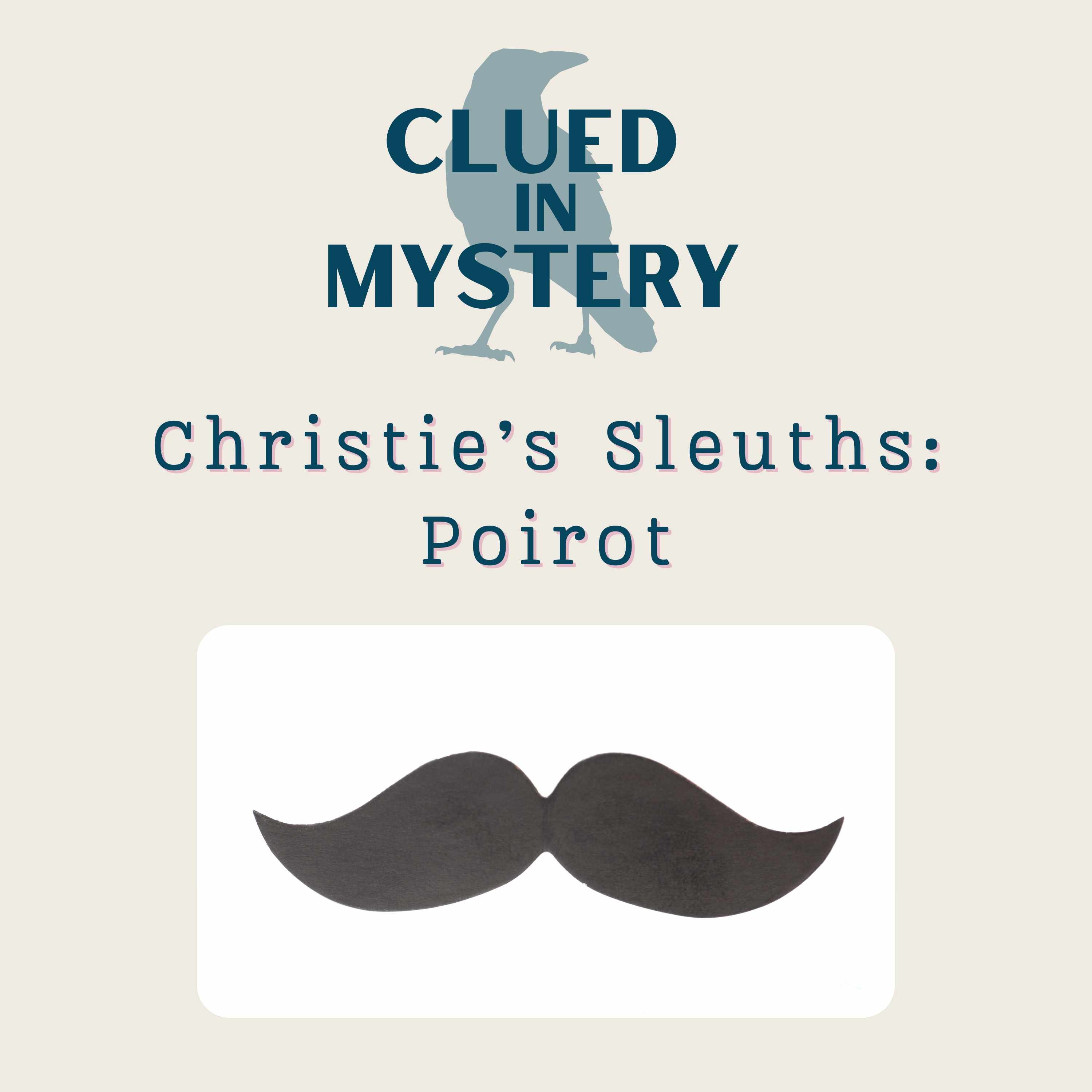
| Brook | And does he have quirks? Perhaps even more famous than the man himself is his mustache. It’s luxurious, immense, and delicately groomed. It has basically a character of its own. Another quirk is Poirot’s green eyes that are repeatedly described as shining like a cat’s. And this happens a lot when he’s struck by an idea. |
| Brook | And he loves his dark hair, which in later stories he begins dying so that it continues to be dark and lush. His outfits are also rather quirky. He has a very unique style of dress, patent leather shoes, is very ah meticulous, as I said before. And then later, these things fall out of fashion, which is a quirk in and of itself. |
| Brook | Poirot suffers from seasickness. He always carries a pocket watch, and he is very particular about his personal finances. His role in Christie’s books does change over time. By the mid 1930s, Christie had perfected a style of story where he spends much of the first third of the novel off the page. And in some books like Hickory Dickory Dock, Poirot is on the page even less. |
| Brook | And, you know, whether this is because of just changing times in the taste of readers or Christie’s own tiring of the character, which we can talk about, it’s kind of unclear, but it’s definitely a pattern we see. |
| Brook | And as Poirot ages and we do see intense cultural changes such as those in the 1960s, Poirot effectively retires. He concerns himself with studying famous unsolved cases and reading detective novels. His death and funeral occur in the novel Curtain, but this was not the first time that Hastings attends a funeral for his best friend. |
| Brook | In the Big Four of 1927, Poirot fakes his death and hosts a funeral in order to launch a surprise attack on the Big Four. Hercule Poirot is the only fictional character to receive an obituary on the front page of the New York Times. |
| Sarah | Well, thank you, Brook. I think there’s so much to say about this character. And, you know, you were describing the way he gets suspects to talk. And we see that in other detectives. And, you know, I think there’s there’s a lot that we see in him that we see elsewhere. |
| Brook | Yes. Yes. I agree. I felt in a way not really knowing where to begin with him because there’s so much to say, um, just about her own work with this detective. |
| Brook | But then, like you said, the way that he’s influenced detective fiction, you know, for over a century now. One example, I think, is the fact that he is almost the prototype for that quirky character, isn’t he? |
| Sarah | Mm-hmm. Mm-hmm. |
| Brook | um ah And that is… Perhaps not fair. I need to look into some of those other sleuths that I mentioned that were influences on Christie, but certainly in the sense of his popularity and how many people read him. And then authors could recognize how much ah readers really enjoyed the idea of this quirky character. It’s different too, because i feel like Sherlock is quirky in a way, but we’re never meant to chuckle or poke fun at Sherlock. But we have that invitation in Poirot and I think, you know, sleuths after that. |
| Sarah | I think you’re right. Poirot is, is, um, he’s a little bit comical. He takes himself seriously, but also is playful, right? |
| Brook | Mm-hmm. |
| Sarah | Like he, you know, he’s very particular as you described about what he wears, about his mustache, his hair. And so ,I guess there are some things for him that would be sacred you can’t make fun of. But he is he’s pretty playful in a lot of the short stories and and the books that that he features in. |
| Brook | I agree. And sometimes when I’m reading a passage where he says something, ah introduces himself as the greatest detective in the world, um on the one hand, I think he very much means it. |
| Brook | But on the other hand, there’s this undercurrent that he knows that’s how that how that’s going to come off, too. He’s doing it intentionally too. So yeah, definitely some playfulness. You see that with his best friend Hastings, even though sometimes he’s a little dismissive of Hastings. I do think that they have some fun banter at times. |
| Sarah | Mm hmm. You know, even that kind of arrogance that he has, ah you know, calling himself the best detective. I wonder if that’s not part of his strategy to throw people off a little bit, right? Because then they’re focused on what he’s just said, and not the questions that he’s asking or the, you know, the, the little slips that that they make in, ah in their answers. |
| Brook | I think you’re right. I think it’s very intentional and that’s just so fun. And it’s fun to think that Agatha Christie, uh, thought that through, right? |
| Sarah | Mm hmm. Well, and and that she thought through his death, right? She wrote Curtain in the Second World War. |
| Brook | That’s exactly right. |
| Sarah | On the on the Christie estate web website, it talks about how um she wrote it ah “during the Second World War as a gift for her daughter, should she not survive the bombings. And it was kept in a safe for over 30 years.” And that was her plan. And she went on to write other stories featuring him after that, but she knew she had this um ending for him. |
| Brook | That’s right. And I think, you know, as much as I know she tired of writing about him, she obviously cared about him because she didn’t want his story to not have an ending. She didn’t want to pass away and then not have a a cap on his story. So I think that the truth was she was very fond of him in her own way. |
| Brook | We get a little bit of a a behind the scenes, I guess, ah telling of how she felt about Poirot when we read her other character, Ariadne Oliver’s ah discussion on the sleuth that she writes about. So this is a fictional character who has a fictional ah author career and her… detective is named Sven Hjerson, and he was a vegetarian Finnish detective. So we have Ariadne Oliver having the same sort of quirky character as Agatha Christie does. |
| Brook | And she tells some funny stories that she doesn’t know why she made him so quirky. It’s quite annoying that she has to. She said, I don’t even know anything about the Finns. And here I am having to write this character. And so we can extrapolate and know that Christie was feeling that way about making this very specific, unique, quirky character that could sometimes be a little bit difficult to write. |
| Sarah | Yeah, I think you’re right. She kind of had that, like, I’m not, I’m not going to say love hate with him, but, um I mean, he paid the bills, right? |
| Brook | Mm-hmm. |
| Sarah | But, I wonder if she felt like she’d kind of, um, painted herself into a corner with him because the, you know, the things that we know about him, the, he’s Belgian, his mustache, his, his dress, he’s got an egg shaped head. |
| Sarah | They don’t give her a lot of flexibility for him to develop very much. Right. And I know that’s one of the criticisms that she faced was that her characters were, you know, there, there wasn’t a lot of character development, but I think that that’s one of the reasons that she endures is that you can pick up a Christie from any point in her library and ah you know what you’re going to get. |
| Brook | Yes, it’s a very um comforting, it’s hard to, I almost called it a series. Of course, it isn’t a series. These are all standalones. But I have that series feeling when I talk about Poirot novels because of that feeling of knowing what to expect. And I think that that can also explain some of the tiresomeness of writing it. i we You hear a lot of authors who talk about, you know, I’m five, 10, however many books deep in a series, and they’ve sort of grown tired of the idea. |
| Brook | But with this being Christie’s mainstay character, her primary character, ah it was it was kind of obligation to continue writing him. |
| Sarah | What about Sophie Hannah’s books that feature Poirot? So those were commissioned by the Christie estate, right? She was asked to write these books. And I know they are very polarizing. People either flat out reject, “no, nobody else should be touching this character”. Or I fall on the side of like, I actually like the books. It’s kind of nice um to be able to read something new featuring this character. And in that, he has a different companion. It’s Edward Catchpool, with a lot of the same kind of dynamic that we see with him and Hastings. |
| Brook | I think that Sophie Hannah has done the best job you possibly can because she didn’t try, she didn’t change him in any great way, just as he was ah somewhat static character for Agatha Christie um You know, she picked up that up and has really kind of kept those enduring qualities about him. But I understand we see that in other series that have been taken over and continued. It’s going to be polarizing, especially by those, you know, diehard fans. |
| Sarah | Brook, what about adaptations? Because I know there are several different versions on screen. |
| Brook | Yeah, we’ve talked about other characters that haven’t had many adaptations or they get written out. Superintendent Battle was written out of many of the books in their TV or film adapt adaptations, but Poirot definitely has the most out of any of Christie’s characters. |
| Brook | The first actor to portray him was Charles Lawton, and he appeared on the West End in a 1928 play called Alibi. And this was an adaptation, a rewriting of The Murder of Roger Ackroyd. So that was the first time we saw Poirot on stage. And probably the most famous is David Suchet who ah portrayed the detective on television. But, um you know, maybe this is me taking the easy way out just because I’m feeling a little melancholy to to be finishing up our series. But what do you think, Sarah, if we plan a future episode to talk about the adaptations, the games, all the way that Poirot has expanded into the world? Because I think there’s a whole other conversation there |
| Sarah | I think you’re right. And I I love the idea of being able to continue to speak about him. So yeah, let’s hold that for another episode. |
| Brook | Yeah that would be great. |
| Sarah | Well, Brook, thank you for this conversation today about one of, if not the most famous detectives. |
| Brook | Of course, Sarah, this was great as usual. And thank you for joining us today, listeners, on Clued in Mystery. Before we go, we have a question of the week for you. |
| Brook | What is your favorite Poirot novel? Until next time, I’m Brook |
| Sarah | And I’m Sarah, and we both love mystery. |