
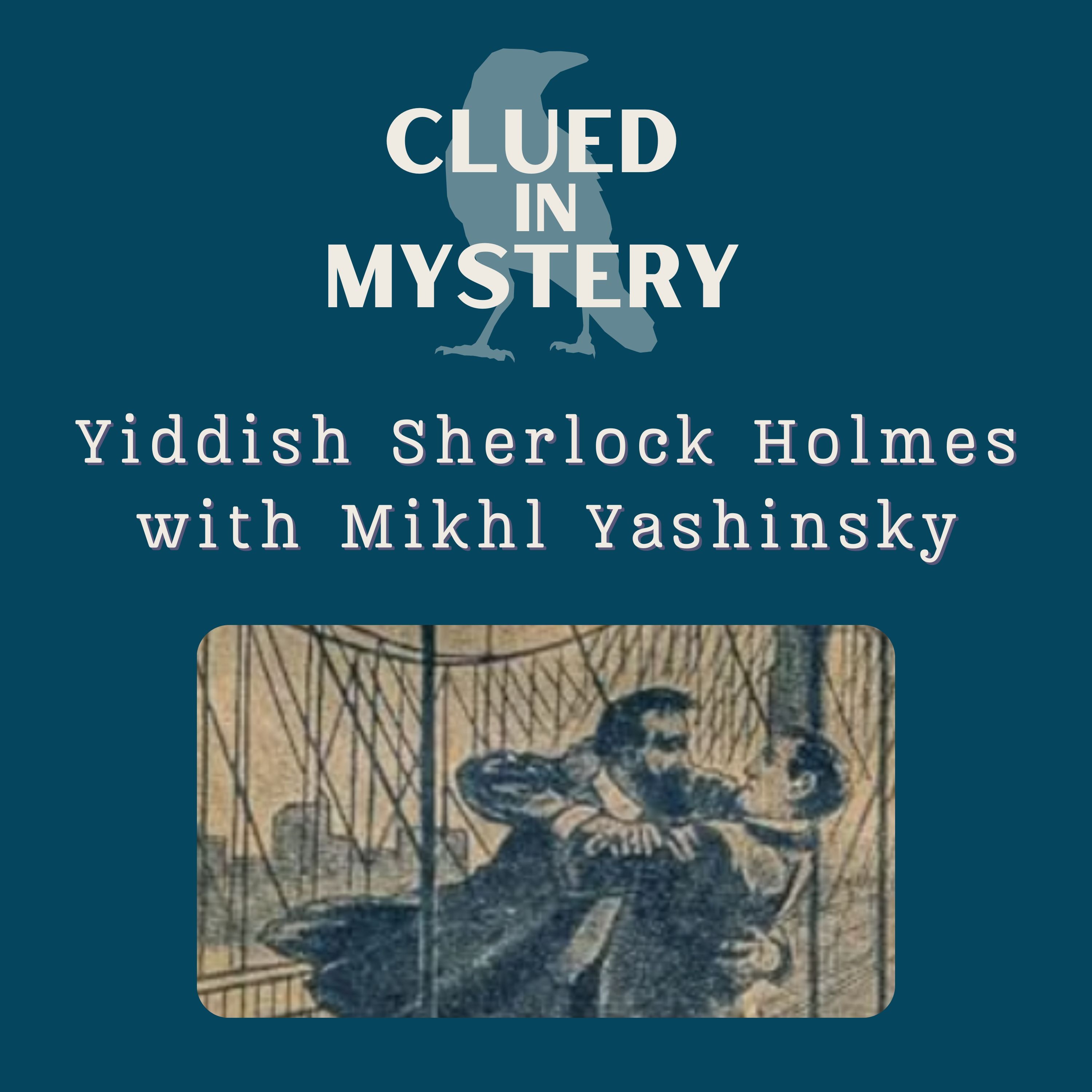
Brook and Sarah are joined by Mikhl Yashinsky, who translated 15 short stories written by Jonas Kreppel in the early twentieth century. Featuring Max Spitzkopf–billed as “The Yiddish Sherlock Holmes”–the stories were incredibly popular with the Jewish community in Vienna, and thanks to Yashinsky, are now available for English readers to enjoy.
Discussed and mentioned
Adventures of Max Spitzkopf (2025) Jonas Kreppel (translated by Mikhl Yashinsky)
About Mikhl Yashinsky
Instagram: @mikhldarling
Website: https://yashinsky.com/
For more information
Instagram: @cluedinmystery
Contact us: hello@cluedinmystery.com
Music: Signs To Nowhere by Shane Ivers – www.silvermansound.com
Sign up for our newsletter: https://cluedinmystery.com/clued-in-chronicle/
Order Life or Delft by Brook and Sarah
For a full episode transcript, visit
Transcript
This transcript is generated by a computer and there may be some mis-spellings and strange punctuation. We try to catch these before posting, but some things slip through.
| Sarah | Welcome to Clued in Mystery. I’m Sarah. |
| Brook | and I’m Brook, and we both love mystery. |
| Sarah | Hi, Brook. |
| Brook | Hi, Sarah. Today, we’re thrilled to welcome Mikhl Yashinsky, a singer, actor, playwright, and acclaimed translator whose work has helped bring new life to early Yiddish literature. |
| Brook | His newest project introduces English-speaking readers to Max Spitzkopf, the Yiddish Sherlock Holmes, written by Jonas Kreppel. Kreppel led an extraordinary life. Tragically, he died in a concentration camp in World War two It’s an honor to learn more about his work. |
| Brook | Thank you, Mikhl, for joining us on the show today. And so tell us to get started, how did you first come across Jonas Kreppel’s stories and what drew you to translate them? |
| Mikhl | Thank you very much, Brook and Sarah. It’s a pleasure to be here talking about these mysteries. ah The book itself was a mystery to me. i had heard about the book from reading memoirs of Isaac Bashevis Singer, who is a well-known Yiddish writer, he won the Nobel Prize for Literature in the 1970s. |
| Mikhl | He describes in his memoirs what he read as a child and among the books that drew him to write and that inspired him about literature were the detective stories of Max Spitzkopf, which he bought at newsstands in Warsaw as a child. So I knew about them from that book, as a lot of people did, but they didn’t know the actual Spitzkopf stories because they were almost impossible to find and are almost impossible to find, except until now, of course, when they’ve been put out in English. But they were published in these little pulpy, cheaply produced pamphlets of 32 pages each, and they weren’t made to last, really. And people consumed them and maybe threw them out, or maybe eventually they were destroyed. |
| Mikhl | Anyway, there are very few. So when I was working at this place called the Yiddish Book Center in Amherst, Mass., we received a donation of books, as we commonly do at the center. And among them was bound edition of five of the stories. They had five of the pamphlets had been bound together as a book. and um You could read just barely on the cover of it that these are the Detective Stories of Max Spitzkopf, but the illustration was actually just a big splotch of black. You couldn’t make out any details. Somehow it had degraded over time. But there they were inside in these crumbling pages, the Max Spitzkopf stories, five of the 15. |
| Mikhl | That was a thrilling discovery and we wanted to translate them. We’ve we knew that they were of great value um as a historical artifact, but also as this living, exciting literary creation, um and that nobody really had read them for a very long time. |
| Mikhl | So we were excited to bring them out. |
| Sarah | Oh, that’s fascinating. ah So, Mikhl, which is your favorite of the stories as you become you know very familiar with them? Is there one that stands out for you? |
| Mikhl | I really like the story called “Medchen händler”, or in English, “The Flesh Peddler”. um This is a story of human trafficking. It really is Some of the stories really ah get very real and very dark. |
| Mikhl | And this is one of those. It’s a story of a girl who’s kidnapped from the shtetl where she comes from, the Jewish town. She comes from in Eastern Europe in Galicia, where Jonas Kreppel, the author, was from. |
| Mikhl | And ah she’s lured away by this man who claims to be an oil tycoon and wants to marry her and elevate her. |
| Mikhl | um So she goes away with him, but is eventually sold into ah brothel in Constantinople in the Ottoman Empire, as apparently was ah routinely done. |
| Mikhl | Back in the day, there were girls who were kidnapped from the shtetl under the same false promises and lured away either to Constantinople or often actually to Buenos Aires and sex trafficked. |
| Mikhl | um So that’s what happens to this girl. And it’s the story of her father’s attempts to locate her and rescue her and eventually engaging the detective Max Spitzkopf, who accomplishes this by visiting the various brothels in Constantinople. or Istanbul as we know it today, and looking for her and asking the other women who are working if they’ve seen a girl like this and talking with the baddies in order to find her. um So it’s it’s a it’s a really dark premise, of course, and difficult, but some at some points it’s treated with a very light touch by the author. That’s a common feature in these stories where there’s a bit of humor, a bit of absurdity. |
| Mikhl | So the scenes of him sitting in the sort of grand salons of the various brothels and talking with the girls ah tend to be pretty funny, actually. The banter between them and his apparent discomfort being around all these women and… um The fact that the women are sometimes trying to pass themselves off as being a little more perhaps exotic than they are um coming from Italy or any such place, but he recognizes their Yiddish accents and knows that they’re from the shtetl. So it’s an it’s an interesting and fun story, actually. Yeah. And at the end, um well, that you’ll have to read, I guess. |
| Mikhl | But most of the stories end ah pretty happily. Yeah. |
| Brook | Interesting. um Well, you you mentioned that these were published rather in sort of magazine type, not meant to be saved. And, you know, many early detective stories were published as serials in that kind of that same manner. um Were Kreppel stories popular in their own time? |
| Mikhl | Yes, they were very popular apparently. ah There are mentions of them in, as I mentioned in Bashevis’s writing, but also in other writers’ writing. |
| Mikhl | There’s one mention of them in the remembrances of a Hasidic Rebbe, a great Hasidic grand rabbi. |
| Mikhl | And he says that as a youth, in Eastern Europe, before he moved to Brooklyn eventually after the war, this is Teitelboim, he would see people reading these books of Max Spitkopf and these crazy stories by Jonas Kreppel and wondering, what is it about these books that people, these that these Jews are reading them as if they’re holy writ um when actually they’re so treyfe, they’re so sort of unkosher, the sort of stories they tell. So he’s at once disapproving of them, but also astonished at how much people are reading and enjoying them. |
| Mikhl | um And he says this forever after remained in the kreppel of his own mind, which he plays a little joke there because kreppel means dumpling, which is also the writer’s last name. But he says “it remained forever in the dumpling or the kreppel of my mind that everyone was reading these books by Jonas Kreppel”. Yeah, they appear to be have been very popular. |
| Mikhl | Later, they were republished in newspapers. um often in serialized form, but in their original form, and it was actually advertised this way on the inside covers, each pamphlet contains a complete Max Spitzkopf story, no serialization. So that was a real drawing point. People who wanted to get the thing and wanted to read it and find out what happens at the end, ah they were drawn to the Spitzkopf stories for that reason. |
| Mikhl | Yeah. |
| Sarah | So it sounds like ah he knew that that the readers wanted to be satisfied, not not to have that that story drawn out. |
| Mikhl | Yes, I think so. ah He was also a publisher himself. That was his trade that he actually learned. He wasn’t a university educated person, but he had gone to, he had trained as a publisher and he actually married ah the daughter of a publisher, Helena Fischer, the daughter of a Yiddish publisher in Krakow, Josef Fischer. And the Spitzkopf stories were published in his father-in-law’s publishing house where he was working in tandem with his father-in-law. So he was definitely trying to write something that would net a lot of money for this publisher, and he was figuring out how to do that. |
| Mikhl | Although interestingly, he didn’t put his name on any of the covers. It was known, it was sort of an open secret, or as they say in Yiddish, assad farggansrod a secret that the whole town of Brod knows. |
| Mikhl | That Jonas Kreppel was the author of these stories, but they were published anonymously. um I think that was a sort of style then. Also, it maybe lent some credence to the story’s claim that these are true stories, that there’s not this fiction author behind them. And on the inside cover, it does say Max Spitzkopf lived and existed, and he really did help all these Jews. um There’s no document that he did, but um that was a sort of selling point as well. |
| Mikhl | And yeah, Jonas Kreppel’s name doesn’t appear on them. |
| Sarah | So the the subtitle is that, ah you know, this is the Yiddish Sherlock Holmes. And um so I have two questions about that. One so we know that Sherlock Holmes and in, when his stories were being published, he would receive letters from readers asking for crimes to be investigated, uh, in, you know, in, in real life. |
| Sarah | So, so real letters from people saying, you know, my neighbor’s disappeared. Can you help me find him? You just mentioned that you know part of the the the way that these stories were sold was that they were sold as if they were true. Do you know if the same thing happened that people would write in asking for Spitzkopf’s assistance? |
| Mikhl | That I don’t know. I’ve not seen any record of that, but I do know that these stories meant a lot to these people reading them in their historical moment. They were being written and published at a time when There was this kind of trafficking going on. There were pogroms in full swing. |
| Mikhl | There was just a couple of years before the Dreyfus affair, which is referenced in one of these stories where it’s called “Der Shpyon”, The Spy”, where there’s a Jew in a military fort, a military officer who’s suspected of spying for the Italians. He’s in an Austrian military fort, and it alludes to the Dreyfus affair in France. But these were real and present concerns in the lives of the readership and of their friends and families. So I think these stories spoke to them in a very direct way. |
| Mikhl | And it was meaningful to them to have this hero, ah this kind of superhero who would rush in and save the day and save the people who were being persecuted. Most of the crimes in the stories are these sort of anti-Jewish crimes. um So I think that was meaningful to them. And to me, I think it partly explains why these stories, unlike some other mystery stories where you’re actually in great suspense over whether the detective can pull it off in the end um and about the fate of the victim. |
| Mikhl | In these stories, it’s you usually have some assurance from towards the beginning that things are going to be OK. You’re there in the lair of the bad guys finding out early on who they are actually so you’re sort of let in on what spitzkopf is trying to find out fairly early but i think in that way it’s somewhat reassuring to the audience that they’re not actually in suspense over whether these people can be caught and who they are. |
| Sarah | So then my my follow-up question is, what do you think makes Spitzkopf similar but different from Sherlock Holmes? |
| Mikhl | Yes. So one way, one big similarity, I think, is the presence of an assistant like Dr. Watson we have here. Hermann Fuchs, who is the assistant who’s always at his side helping him, often getting into trouble because he has less know-how and ah is a little more rash than Spitzkopf, so he’s often getting whacked on the back of the head and being thrown into some cellar somewhere, and Spitzkopf has to go and find him and save him on the way to saving the actual victim at the heart of the story. ah But that dynamic between the two is is somewhat of a Holmes and Watson dynamic, although different. um And the closeness between them. There’s scenes of great sort of heartwarming intimacy between those two characters where they’re helping each other out and confiding in each other. |
| Mikhl | In general, these stories I think are more swiftly plotted than some of the Holmes stories. Some of the Holmes stories are almost novel length, um whereas these are all exactly 32 pages and they’re sort of detective stories, but also action stories in a way. The detectives are always jumping right in and going from one place to the next. |
| Mikhl | Finding clues, yes, but less about sort of deep analysis and deduction from these clues and more about just racing into action, overhearing people’s conversations, um nabbing the bad guys, et cetera, et cetera. But um in a way, I feel like it’s almost like the Jews in these stories don’t have the luxury of time that Holmes has, where he’s often helping out English aristocrats, people of wealth. These people are all sort of desperate people in desperate social and financial circumstances, and they just don’t have the time. So we need to save these people um ah while the iron’s hot in a way. Yeah. |
| Brook | Well, you’re known for your work in Yiddish theater and film. So I’m wondering, do you imagine Max Spitzkopf ever finding a second life on stage or her screen? |
| Mikhl | I would love that. I think these would be really well suited to ah theatrical telling or filmic telling. um They’re very kind of unique in their setting and in the sorts of characters we find in them as far as detective stories go. And I think they would be a lot of fun. We are doing a sort of first foray at this. um This may come out after it happens, but it’ll be January 29th at this place called the Vilna Shul in Boston, where they put on, it’s an old synagogue and today they put on a lot of wonderful performances there. And we’re doing sort of a theatrical reading of one of the stories where we’re leading the audience on a clue finding mission as we read the story. And there will be live music from a wonderful trio led by Abigale Reisman. So we’re um working on that and we’re writing some music for it and some songs. |
| Mikhl | At one point, Hermann Fuchs, in the story of “The Gravedigger”, which is the one we’ll be doing that night, he sings a song pretending to be a sort of drunken beggar on the street. um He does this so that the bad guys will move away from him and they’ll go and seek the security of a streetlamp. And while they’re illuminated by a streetlamp, Spitzkopf, who’s on a second level nearby, will be able to spy on them ah more easily. Anyway, he sings a song as a sort of drunken song. So we’re doing that song, we’re writing music to it. ah Abigail has found a wonderful sort of old Viennese tune that we’re using. |
| Mikhl | And then at the end, there will be a Spitzkopf theme, Max Spitzkopf theme, where we’re writing a a brand-new song, um taking inspiration from The Third Man has this wonderful, it’s The Third Man is, of course, this wonderful noir 1940s mystery drama set in Vienna, as these stories are. um And it has a great theme played on the zither. |
| Mikhl | So we’re taking inspiration a bit from that tune and that style and writing Spitzkopf, his own theme tune. So maybe someday we’ll use that again in a larger production. We’ll see. |
| Brook | Oh my goodness. I wish I could travel and ah and be there for that production. It sounds wonderful. And I just love to see like the expansion and the adaptation of any mysteries, but especially this one, I think it’s going to be so culturally rich and very special. |
| Mikhl | Thank you. |
| Brook | So I wish you luck with that. |
| Mikhl | Thank you. Thank you. Thank you. Yes, I agree. Yeah, it should be. it should be cool. |
| Sarah | Mikhl generously shared some of that music with us. |
| [Music plays] | |
| Sarah | Now that you’ve brought Kreppel’s detective into the spotlight for English speakers and English readers, are there any other Yiddish mystery writers that are on your radar? And do you think we might see some more translations from you? |
| Mikhl | I think I have to do some hunting to find other mystery authors I could translate. It wasn’t the most common genre in Yiddish, although the world of Yiddish pulp fiction actually is quite large. um And this was called in Yiddish shund, which means essentially trash. |
| Mikhl | And these were stories that were pulpy, written purely for entertainment’s sake, weren’t well regarded by the literary elites, but were devoured by the Yiddish readership. um And there’s a lot of… ah treasures in this shund that remain to be discovered and very little has been published in English translation because it’s not the thing that traditionally would get translated and published. But today there is a growing interest in it. So I, I think it would be fun to find another shund gem and translate it. |
| Mikhl | There are actually others from this writer, ah from Jonas Kreppel. These are the only Spitzkopf stories that exist, but he did write other stories in this sort of pulpy genre. um And I found actually at the back of another of his stories, there was a list of all of the stories he’s published. And so there are some fun titles there that it might be fun to look into and do ah maybe a set of 10 or 15 of these other pulpy stories, all of which are also exactly 32 pages long. Um, but there’s one called, for instance, “Fergrobener Zilber-Rubel” “The Hidden Silver Rubles” or that “Der Eydim a Merder” “My Son-in-Law, The Murderer,” and things like that, that seem kind of enticing. |
| Sarah | Oh, those sound fascinating. I, I think it’s really interesting the, I think you said it translated to trash, the name that was given to these stories. and And that seems to be kind of a universal, I mean, I I don’t think I’ve ever heard them explicitly referred to as as trash, but genre fiction, you know, not being well respected by let’s say literary elites, but exceedingly popular among readers. |
| Mikhl | Yeah. Yeah, I think there’s something really interesting and special about that and worthy of attention. And i think these stories, although they were once considered trash, are actually just as sort of wonderful and entertaining to us as they were back then. There was something that made them. so readable and I think there still is. so um I think they’re a great source for escape and entertainment and also with these particular stories, a certain kind of edification because as we’re reading these exciting stories, we also are learning about this interesting milieu and this culture and this history. Yeah. |
| Brook | I think these stories also speak to how universal mystery is. You know, we’ve found that time and time again. Sarah has been great about finding mystery authors from around the world to read and share. And this is just another example of how universal these, you know, tropes and the idea of, as you said, kind of the superhero who’s able to solve the problem. It’s innately human, it seems. |
| Mikhl | I think so. I think we read these stories and we’re amazed by a person’s bravery and intelligence and fearlessness. And it can be very inspiring to read stories like that. And as we read them, we sort of hopefully are not only entertained, but also inspired to be as brave, as cunning, as fearless, as helpful as some of these heroes are. I think that’s one thing that connects them and makes them so interesting to us and so beloved. Yeah, I agree. |
| Sarah | Well, Mikhl, thank you so much for joining us today. It has been really such a treat to hear from you. Before we go, can you share where our listeners can find you and find copies of these mysteries? |
| Mikhl | Yes. I can be found at yashinsky.com. I was lucky enough to get that yeah URL. So that’s just my last name.com or they can follow me on Instagram @ MikhlDarling, ah which I took as the inspiration for that name came from another literary ah hero of mine, which is the youngest son of the Darling family of Peter Pan, Michael Darling. So not Michael Darling, but MikhlDarling, as I’m also the youngest son of my family. |
| Mikhl | And the book can be bought at really any online book retailer. Search for Adventures of Max Spitzkopf, and you can find it at whichever one you please. um Also directly from the publisher, which is the Yiddish Book Center. um So if they search Yiddish Book Center Adventures of Max Spitzkopf, they’ll be able to find that link and buy it directly from the White Goat Press, which is the publisher of this institution, the Yiddish Book Center. |
| Sarah | Wonderful. We’ll We’ll make sure to add some links to the show notes for that. |
| Mikhl | Terrific, thank you. And thank you very much for having me. It was a delight to talk with you both. |
| Brook | Thank you so much for joining us today. And thank you listeners for joining us on Clued in Mystery. Until next time, I’m Brook. |
| Sarah | And I’m Sarah, and we both love mystery. |