
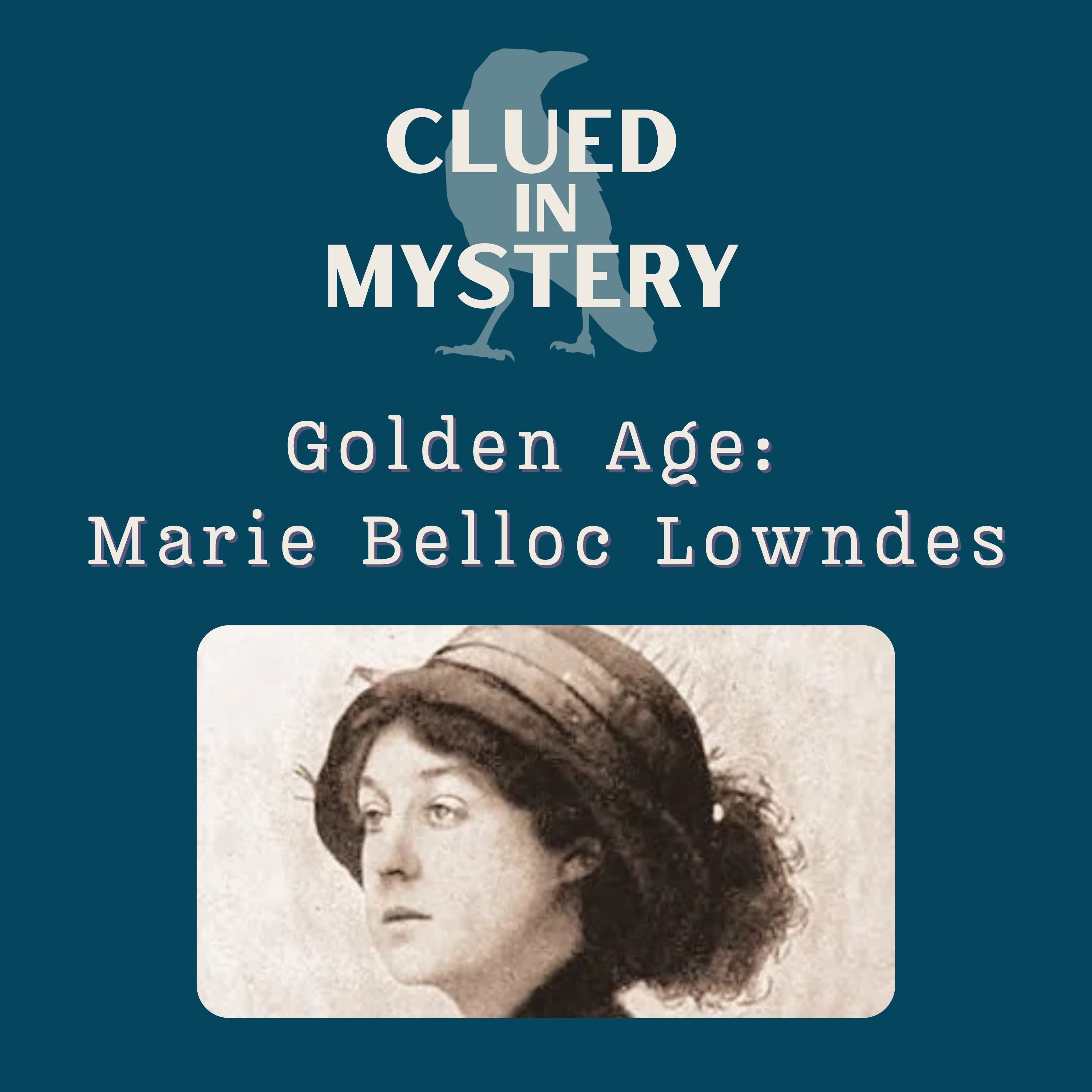
In today’s episode, Brook and Sarah discuss Golden Age author Marie Belloc Lowndes and the striking similarity between one of her characters and one of Agatha Christie’s, as well as the legacy her writing left on the mystery genre.
Discussed and mentioned
The Lodger (1913) Marie Belloc Lowndes
The Lonely House (1920) Marie Belloc Lowndes
The Mysterious Affair at Styles (1920) Agatha Christie
The Life of Crime (2024) Martin Edwards
The Golden Age of Murder (2015) Martin Edwards
Noted Murder Mysteries (1914) Marie Belloc Lowndes
Lizzie Borden: A Study in Conjecture (1939) Marie Belloc Lowndes
For more information
Instagram: @cluedinmystery
Contact us: hello@cluedinmystery.com
Music: Signs To Nowhere by Shane Ivers – www.silvermansound.com
Sign up for our newsletter: https://cluedinmystery.com/clued-in-chronicle/
Order Life or Delft by Brook and Sarah
Transcript
This transcript is generated by a computer and there may be some mis-spellings and strange punctuation. We try to catch these before posting, but some things slip through.
| Sarah | Welcome to Clued in Mystery. I’m Sarah. |
| Brook | And I’m Brook, and we both love mystery. |
| Sarah | Hi, Brook. |
| Brook | Hi, Sarah. Today we’re going to talk about an author that I’m guessing even our very astute mystery listeners may have never heard of. |
| Sarah | Yes, I’m very excited about this. |
| Brook | I am too. So our Golden Age author this time is Marie Belloc Lowndes, a writer whose career actually began well before the Golden Age, but continued through nearly that entire period. Marie Belloc was born in London in 1868, but spent most of her childhood in France. Her father, Louis Belloc, was a French barrister. Her English mother, Bessie Raynor Parks, was a journalist and an advocate for women’s rights. |
| Brook | Marie’s younger brother was Hilaire Belloc, who also became a prominent writer, focusing mostly on social and political commentaries. Marie began writing professionally as a young woman initially working as a journalist like her mother. |
| Brook | In 1896, she married Frederick Sawrey Lowndes, and he was also a journalist. Together, they had three children, and Marie continued building her writing career right alongside her marriage and her family life. |
| Brook | She was. incredibly well connected. Lowndes moved in literary and political circles, and she kept extensive diaries of these interactions and and meetings that she had. um And during this time, she also developed a particular fascination with famous crimes, and murder trials. That fascination became an important part of her fiction. Her breakthrough The Lodger, was first written as a short story and then she reworked it and it became a novel in 1913. |
| Brook | And this was inspired by the Jack the Ripper murders, and it follows a London couple who begin to suspect that this mysterious man who’s been renting a room in their home may actually be the killer. The book became her best known work and was later adapted by a young Alfred Hitchcock into a silent film. Several other film adaptations have been made, and even most recently in 2009. |
| Brook | Lowndes returned repeatedly to real crimes for inspiration. Her stories often focused less on the fair play puzzle we associate with Golden Age detective fiction and more on psychological suspense. She was remarkably prolific. Over her career of more than 50 years, she produced 40 novels, many short stories, plays, memoirs, and works of nonfiction. |
| Brook | She even created her own French detective named Hercules Popeau, and his similarities to another famous detective will give us something interesting to talk about later. Lowndes continued writing into the 1940s, publishing mostly autobiographical works later in life. She died in 1947 at the age of 79. |
| Brook | Today, she’s remembered primarily for The Lodger, but her career touches on a number of things we still talk about in mystery today, like true crime, psychological suspense, and the importance of a really good plot. |
| Brook | I don’t know. I just think she is such an interesting woman, Sarah. And she seemed to have it all. Marriage, family, education, creative pursuits, thriving career. I think she was just well before her time. |
| Sarah | I get that impression as well, Brook. um And Martin Edwards makes a similar comment in one of his books that um you know she was writing, as you say, these more suspenseful books at a time when it really was those fair play mysteries that other Golden Age authors are known for. And so her writing didn’t quite fit in to what was really popular at the time. |
| Brook | That’s right. That’s right. And this perhaps is one of the big reasons why she was never a member of the Detection Club. She was writing throughout the Golden Age. But, as you say, her work wasn’t often that fair play puzzle mystery that we associate with the Club. And you and I recently discussed the rules of mystery that they set forth. And she was not writing that type of story. |
| Brook | Whether that really explains her absence from the club is harder to say, but… it does, I think put her on a different branch of the mystery family tree so to speak. She seems to kind of be the seminal part of the psychological or domestic thriller branch. |
| Sarah | Yeah, and I mean, if if… Hitchcock was adapting her work, then that’s a pretty strong signal in terms of like where her books fell in that, as you say, in that family tree of of mystery. |
| Sarah | I read The Lonely House, which was released in 1920. And I believe it’s the first book that features her detective, Hercules Popeau. uh and That’s the same year that Agatha Christie wrote The Mysterious Affair at Styles and introduced everybody to uh Poirot. There were a lot of similarities between those two detectives, and we can talk about those. very specific similarities. um and so i can see why she was upset but Martin Edwards says in his book The Life of Crime that ah It just was it was just a coincidence that these two characters emerged at the same time. |
| Brook | That is incredible, isn’t it? um Yes. You know, we touched on this briefly when we did our deep dive into Poirot. ah because we… It was at that time that we even learned about Popeau. |
| Brook | And. I remember us saying like, “Oh, I wonder which one came first”. And that’s about as much as we knew. But um so this really gave us some more information in the story behind that and Lowndes herself did not regard the similarity as coincidence. She went to the Society of Authors and claimed that Christie had effectively taken her character and wanted compensation. |
| Brook | And she felt that Poirot’s enormous success hindered her from being able to carry on with her, you know, she would look like she was copying Poirot, even though she claims it was the other way around. But I think what reflected in the Martin Edwards information, the chronology is apparently really complicated. Because as you say they both came out in 1920. And Christie has notes and in her diaries that she began writing about Hercule in like 1916. So, it’s not straightforward and it’s very mysterious. And kind of incredible that they would come up with such not only similar in a character, but also similar in names. |
| Sarah | Very similar names. And yeah, very similar characters, both retired policemen. um In The Lonely House, Popeau is referred to as a secret agent. |
| Sarah | I read one of her short stories as well, and he’s referred to a couple of different ways. So, I think he’s referred to as a secret agent. He’s referred to as a retired detective. So, you know, she may have been kind of still working out which is what his backstory was. |
| Sarah | But um one thing that I thought was really interesting is that. Both of those characters refer to themselves as Papa, so I think in Styles, Poirot says, you know, you can call me “Papa Poirot”. And in The Lonely House, he refers to himself as Papa Popeau. |
| Brook | Oh my goodness. |
| Sarah | And. Right. Like. I… see why she pursued this because wouldn’t you? Reading you know, Agatha Christie’s book who now I don’t think she was you know Styles was not a runaway success. If you remember. |
| Brook | Mm-mm. |
| Sarah | Right. Even so, can you imagine? Reading just this very similar character. You would feel like, yeah, this woman has totally ripped me off. And then the phenomenal success that Christie went off to to have. I, I think partly because of the style of mystery that she was writing. So The Lonely House is not. Ah you know It takes a while before the first body. And there’s it was… it was good. I liked it, but it wasn’t. Like. We weren’t detecting. We weren’t searching after clues. And I think part of that is because she wasn’t that interested in that. She was really interested in the why. |
| Brook | Mm hmm. More of the motives, the personalities, the psychology behind things. And that was going to be my question because I read The Lodger this week and I… I had not have not read a Popeau book yet. But it sounds like it’s similar in the fact that it’s more of a thriller story than you know, a a puzzle mystery. |
| Sarah | Mm hmm. Mm hmm. Like I said, I liked it, but it definitely was not a a classic whodunit. |
| Brook | Well… the rub I guess between the two ladies could also be a reason why Lowndes was never probably interested in being in the Detection Club and did not receive an invitation. |
| Sarah | Yeah, and I i think you’re… absolutely correct, Brook. I can imagine that you know Christie was going to have none of that uh you know this woman’s accused her of of stealing her character and Christie would have been quite clear that that that that hadn’t happened. Um, And I think they were just two very different women. Right. I get the impression that Lowndes was a much more she wanted to be in the spotlight. She had this, you know, great social life. She was very well connected with people who were the thinkers and the artists and the politicians of the day. |
| Sarah | Right. And I don’t. Get the impression that, you know. that Christie pursued any of that she might have known some of those people but it was not that she was seeking those relationships. |
| Brook | Yeah. From everything we’ve learned, she was very, um, private and didn’t want to be in the limelight or being in a lot of social situations and Lowndes was very much the opposite. |
| Sarah | So you you read The Lodger and that is the one that is inspired by Jack the Ripper. That’s what you said, right? |
| Brook | Yes. |
| Sarah | So in in one of Martin Edwards’ books, he makes a comment that the kind of sleuth from that book is is the maid right uh and it was unique because very few of any of the books that are inspired by jack the ripper had female protagonists or female investigators. |
| Brook | Oh. Oh, that’s very interesting. Yes the So in the In the book, the main character is… a I guess a retired maid. um She’s married to a man who had been a valet. And so now they’re later in life and they’ve married and they have their own home. But they’re really down on their luck, so they take in this lodger, but. Yeah, I was struck by the fact that like she she had was giving a voice to somebody who had been a servant her whole life but i had really never taken it to the leap that like oh and it’s a and it’s a woman who’s a narrator because we’re used to that all the time. We have female narrators of books maybe predominantly in the domestic thriller world but you’re right it would be very um new and different in the age that Lowndes was writing in. |
| Sarah | Yeah, when I think about books that we’ve read from kind of the the early writings of of crime fiction. There aren’t a lot of female sleuths. um We talked about Anna Katherine Green having Amelia Butterworth. And of course, there was Miss Marple that is Agatha Christie’s creation. But yeah, there just weren’t a lot of books featuring females as the primary characters or primary primary sleuths. |
| Sarah | And in uh The Lonely House, this story centers around a young woman.um And she kind of pieces it together. But it’s not, it is told mostly from I guess mostly from her perspective. She’s not the narrator. It’s not first person, but it’s told from her her point of view. |
| Brook | Yeah, and that’s a great point. uh The Lodger is the same. Mrs. Bunting is the point of view character, but it’s actually told in a in third person um but i do want to say that the um the lodger the mysterious person in their house introduces himself as Mr. Sleuth So it’s quite fun. |
| Sarah | Oh, I like that. Lowndes’ name comes up. in The Golden Age of Murder, which is by Martin Edwards. As someone who was potentially the author behind the Francis Isles pen name. So… You know, we did a episode about Anthony Berkeley, who is Francis Isles, ah but… you know when those books first came out there was a lot of speculation about who could be the author and her name was amongst those being being considered. |
| Brook | Oh, that’s fascinating. And I can see why, because we discussed how that was more of a domestic thriller type story. So they would be similar to some of the things that she was publishing. |
| Sarah | And it would be interesting, I you know, I don’t know., did you find anything, Brook, about her whether she did publish anything under a pen name, because she may have uh considered it to try maybe try and separate herself from this…. I have to imagine it was just this bitter taste in her mouth about Agatha Christie. |
| Brook | Yeah you’re right I did not come up with anything or find anything along those lines but I think that could have been hurt. I think that could have been a really great tactic for her is to basically start again. um She was well connected, she would have got a contract you know um. So maybe that would have been a way for her to distance herself from this what had to be terrible conflict. And you know what I’m so surprised that we don’t hear more about that. It just surprises me that this story isn’t out in you know public knowledge more. |
| Sarah | Yeah, it just seems to be a footnote in. Mystery history. |
| Brook | Well, I mentioned in the intro that um she was very fascinated with true crime. And that’s definitely something we see today. There’s so many podcasts, so many TV shows. And I think we get the feeling that this is something um contemporary. But clearly, Lowndes reminds us that it is not a new phenomenon. |
| Brook | People in her time were following the sensational murder trials or crimes just like we do. And… I thought it was really interesting. Some of her diaries show that she attended the Titanic inquiries. |
| Brook | And I was just thinking how intriguing that must have been for her. She was somebody who loved to watch people and loved to be out and about. And the material was just…oozing from that thing the people watching so many emotions, so many individual stories to take in. And how fascinating to be at the right place at the right time to attend those. |
| Sarah | Well and she might have known some of the people who were on the Titanic, given the circles that she was traveling in, right? |
| Brook | Good point, Sarah. |
| Sarah | And so she may have had some like personal interest uh to attend. |
| Brook | Yes, that’s an excellent point. |
| Brook | As we mentioned, she did publish nonfiction, and one of those books was Noted Murder Mysteries, in 1914, reflecting her interest in true crime. And then in 1939, she published Lizzie Borden, A Study in Conjecture. So this is more like a creative nonfiction. She’s sort of surmises what really happened. And I would love to get my hands on both of these, although I’m sure they’re both out of print. It could be a feat. |
| Sarah | Oh that sounds that sounds really interesting and it would be Like she would have been most. She would have been closer in time to those events. just have a different perspective than someone who would be writing about those now. |
| Brook | Absolutely. Yeah. And and living at that time would make. the crime feel differently. I mean, these are historic crimes to us. And I i have to think back about what I said about that Titanic that it would be so great well it wasn’t great at all because they had just lived through this horrible tragedy, so i think that my perspective is a little bit different than what it felt like in her day. |
| Sarah | You know, Brook I think you’re right in the introduction when you said that she’s an author. for whom a lot of people she may be new because they just hadn’t hadn’t heard about her. But um when she was publishing, she was recognized as as writing great books. and Um, Ernest Hemingway and Gertrude Stein, for example, really liked The Lodger as well as A Chink in the Armor, which is published in 1912. |
| Sarah | And maybe this has something to do with. Again, the like. famous friends that she had. ah But Her work was respected, even if it wasn’t what readers were really clamoring after. |
| Brook | Mm hmm. Exactly. She was a great writer, period. You know, she was a journalist and many of the best mystery writers that we’ve talked about have a journalism background. And I think that the. the way they tell a story and especially in crime fiction, it all just really melds really nicely. And um I can see why maybe these more literary authors were still appreciating her work. |
| Sarah | Well, and I found, you know, I listened to The Lonely House and it didn’t feel like it was over 100 years old to me. |
| Brook | No, I felt the same way about The Lodger. With a contemporary thriller, I sometimes…just have to binge it because I have to know what happens. And a lot of times for me, when I read Golden Age work, I don’t get that same feeling. I’m still invested. I still want to read the story, but I don’t get that like almost can’t put it down feeling just. It’s just the distance from the language and and all those types of things. But that wasn’t the case with the lodger. I was locked on and I really had to find out what was going to happen. |
| Brook | So I think she had that ability to keep the suspense going. She was really skilled at basically making a new genre in a way. And she has this quote about um having what she called a plot mind. She was not afraid to boast about her writing skills, apparently. And she said, you know, “I have a plot mind, and I am able to draw in readers.” I mean, and she’s right. She was. |
| Brook | And she said that there were two other authors that she thought also had a plot mind. I don’t know if this is an exclusive list, but she did list two as Wilkie Collins and Dumas. So, she was putting herself in pretty high regard. She was not afraid to say, “I’m good at what I do.” |
| Sarah | She sounds like just an absolutely fascinating woman. |
| Brook | She really does yeah. |
| Sarah | Brook, I’ve really enjoyed this conversation and learning a little bit more about Mary Belloc Lowndes. |
| Brook | I have too, and I ah plan on reading more of her work. ah But, we do have a question of the week for you listeners. Has a real-life crime ever led you to pick up a mystery novel? Or maybe sent you down a research rabbit hole? Reach out to us via email or our socials to let us know. We’d love to share some of your answers on an upcoming show. |
| Brook | But until next time, thank you for listening to Clued in Mystery. I’m Brook. |
| Sarah | And I’m Sarah. And we both love mystery. |


