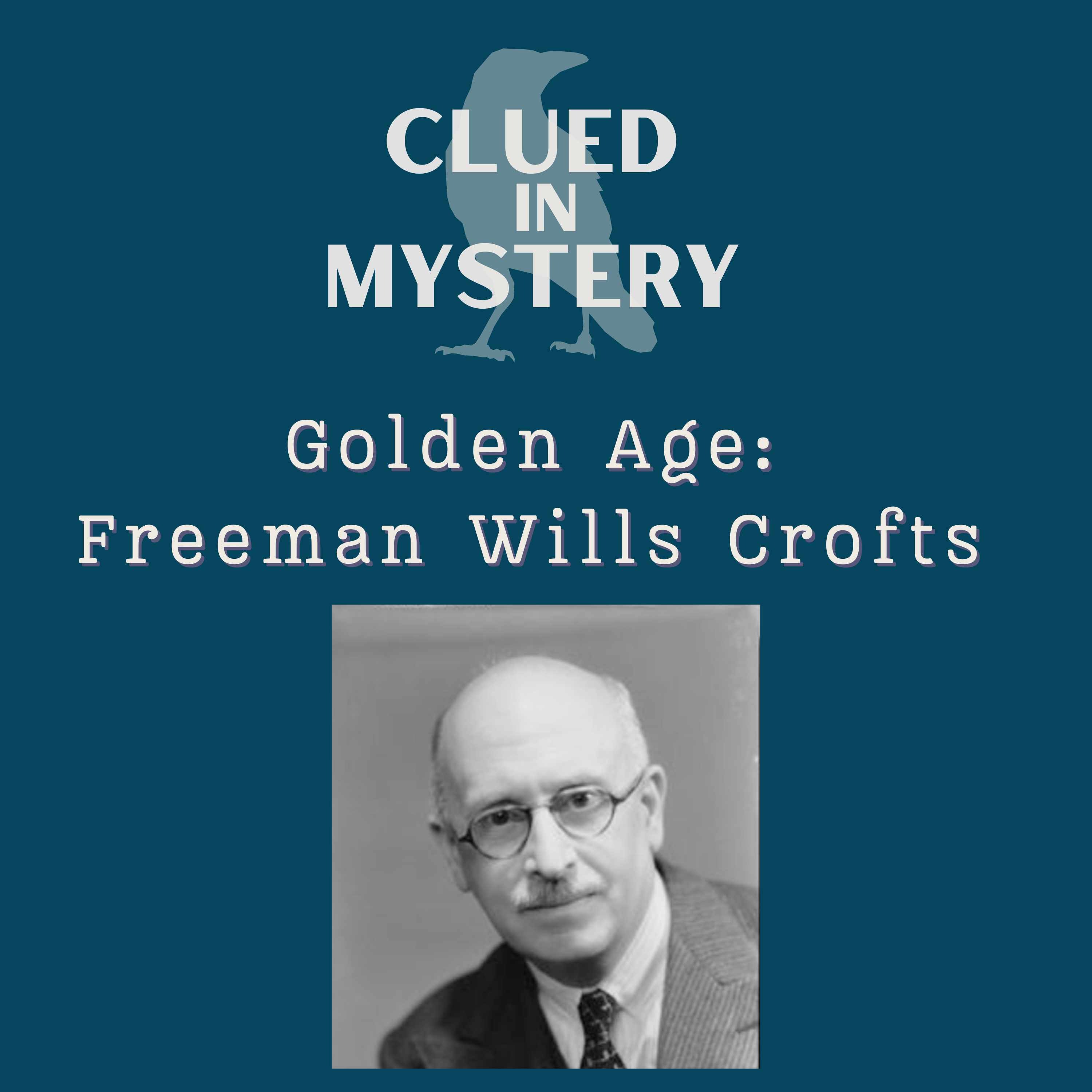
In today’s episode, Brook and Sarah continue their exploration of early mystery writers and discuss author Freeman Wills Crofts.
Discussed and mentioned
The Cask (1920) Freeman Wills Crofts
Inspector French’s First Case (1924) Freeman Wills Crofts
Sudden Death (1932) Freeman Wills Crofts
Golden Age of Murder (2015) Martin Edwards
The 12:30 From Croydon (1934) Freeman Wills Crofts
The Life of Crime (2022) Martin Edwards
For more information
Instagram: @cluedinmystery
Contact us: hello@cluedinmystery.com
Music: Signs To Nowhere by Shane Ivers – www.silvermansound.com
Sign up for our newsletter: https://cluedinmystery.com/clued-in-chronicle/
Order Life or Delft by Brook and Sarah
Transcript
This transcript is generated by a computer and there may be some mis-spellings and strange punctuation. We try to catch these before posting, but some things slip through.
| Sarah | Welcome to Clued in Mystery. I’m Sarah. |
| Brook | And I’m Brook and we both love mystery. |
| Sarah | Hi, Brook. |
| Brook | Hi, Sarah, today we’re discussing Freeman Wills Crofts, an influential yet often overlooked writer of Golden Age detective fiction. Born in Dublin, Ireland in 1879, Freeman Wills Crofts was named after his father, who sadly never met him, having died before his son was born. His mother remarried Archdeacon Lett, and Crofts spent most of his childhood in the vicarage at Guilford. This is a small village in what is now Northern Ireland. |
| Brook | In 1912, Crofts married Mary Bellis Canning. She was the daughter of a banker and the couple remained married for 45 years until Crofts’ death in 1957. They had no children. |
| Brook | With an uncle in the railway industry, Crofts trained as an engineer and spent much of his life working in that field. He was involved in major engineering projects of the era, including the design of the Bleach Green Viaduct near Belfast. |
| Brook | His engineering background would later become one of his greatest strengths as a mystery writer. If you’ve read a Crofts novel, you’ve probably noticed something distinctive about his storytelling style. He pays an extraordinary amount of attention to logistics, measurements, timetables, and physical space. Readers always know where characters are, how they got there, and exactly how long a journey took. |
| Brook | This level of detail can feel odd to us modern readers, but it was perfectly suited to the puzzle mysteries that were so popular during the Golden Age. Crofts came to writing almost by accident. In 1919, during a lengthy illness that took him out of work, he began writing his first novel, The Cask, and it was published a year later in 1920. |
| Brook | The book was an immediate success and established him as an important new voice in detective fiction. Over the next 30 years, he wrote almost a novel a year, producing a remarkable body of work that included classic detective stories, locked room mysteries, thrillers, and even those inverted mysteries we recently discussed. |
| Brook | This is where readers know the identity of the criminal from the outset and then watch the detective slowly unravel the crime. Crofts is best remembered today for his Inspector Joseph French character, and he first introduced him in Inspector French’s Greatest Case in 1924. |
| Brook | Unlike some of the more eccentric sleuths of that era, French wasn’t quirky or even very memorable on his own. He was simply a police officer who solved crimes through patience, solid investigation and attention to detail. |
| Brook | He became known as an alibi buster. This was his special skill, dismantling apparently perfect alibis. And Croft’s intricate knowledge of transportation networks enabled him to give his sleuth this gift. |
| Brook | His mysteries often revolve around the practical question of whether a suspect really could have been where they claimed to be. In fact, his engineering mindset is everywhere in his fiction. His contributions to the mystery genre were recognized by his peers as well as readers. Crofts was an original founding member of the famous Detection Club, and in 1939, he was elected a Fellow of the Royal Society of Arts. |
| Brook | While he may not enjoy the same level of fame today as some of his contemporaries, Freeman Wills Crofts is a writer whose engineering expertise, intricate mystery plotting, and hardworking police detective helped shape the genre in lasting ways. |
| Sarah | Thank you for that introduction, Brook. I think it’s so interesting that, you know, he started writing at the same time as Agatha Christie, but he’s nowhere near as well known as she is. |
| Brook | No. And yes, they definitely have their own style and bent, but really when it comes down to it, they were both telling the same types of stories. And so, it is interesting how one name endures and another really gets kind of lost to time. |
| Sarah | Do you think some of that, I mean, the Christie estate does so much work to keep her characters on screen to republish her books. You know, there’s a Sophie Hannah’s continuing of Poirot stories. And I think later this year, there’s a Lucy Foley continuation of Miss Marple coming out. I’m sure that that contributes to her continuing to be quite popular. For Freeman Wills Crofts, you when the last adaptation of his work was? |
| Brook | Yeah, so um he did have some adaptations, but most of them happened during you know his heyday. ah Sudden Death was adapted into a stage play called Inspector French in 1937. And then he later reworked that and retitled it to During the Night. And I thought this was fun. As a special touch, the production opens and assures the audiences that all the clues would be available for them to solve the mystery before the second act. So I thought that was a very Golden Age and fair play. And then, of course, he did like short plays for the BBC and radio adaptations for his stories. But there again, and that was during kind of his popularity of his life. |
| Brook | But to answer your question, in 2019, Free at Last TV, this is the producers of the Agatha Raisin series, and they announced plans to develop an Inspector French television series, which I thought sounded like that that would be so great. And as you say, kind of reignite the the awareness of this Golden Age guy. um But, we all know 2019 was a terrible time to start working on any project because the COVID restrictions would have soon started. And it looks like that project has fizzled. But I don’t think we should give up hope that there are people out there that are looking at this man’s work and thinking like this would be a different um it’s just a different viewpoint I think on these mysteries because we’re not talking about the drawing room manor house type of mysteries they’re in a sense they’re ah you know, a little more masculine in a sense that they’ve got this like ah very mechanical and logistical way of looking at it. And I think that it would appeal to a certain part of the mystery community that doesn’t necessarily need all the emotional or psychological character development. |
| Sarah | Yeah, that’s ah that’s a really interesting point because, as you said in your introduction and and just now, um there’s a different feel to his books. I know Martin Edwards has done a lot, I think, to try and keep ah Freeman Wills Crofts in readers’ spotlights. |
| Sarah | So he has um been part of, i think it’s Poison Pen Press and the and the British Library that are re-releasing kind of Golden Age, uh, classics. And, um, Martin Edwards often provides the introduction those. |
| Sarah | Um, and he talks about, um, Crofts in his, uh, in his books, like in Golden Age of Murder, he talks about him. I think Martin Edwards is trying to make sure that his name is not lost, but it may be a bit of an uphill battle. um But I would love to see Inspector French um on screen because he he is a little bit like… |
| Sarah | I wouldn’t say that Poirot is flashy, but, you hear his name and and and there’s things that you definitely associate with him, and I struggle to kind of do that with French. I would say the cask and the French novel that i that I read were both pretty like procedural. |
| Brook | Yes. Yes, absolutely. I think that that he is a forerunner to the police procedural. As far as I could tell, until his series with French, none of the other authors were using a policeman as their primary repeating sleuth. They were amateur sleuths, or or in Poirot’s case, he’s retired from the police but police force. So this was something kind of new, but definitely a line you can trace directly from current police procedurals to Croft’s work. |
| Brook | And I was actually thinking about our recent discussion of Lynda La Plante. I mean, obviously their work is very different, but La Plante, it was our modern great this season. Because she is writing in these modern times, she’s much more interested in character psychology and the emotional impact of crime and all those wonderful things that we talked about when we covered her. |
| Brook | But both of them are writing from the viewpoint of police professionals. And it was completely by accident that we chose those two authors, but I don’t think it could have turned out any better because we can kind of look back to Crofts as a forerunner to the work that Lynda La Plante is continuing to do now. |
| Sarah | I did actually think of, um i don’t know if it was specifically Lynda La Plante or just like. modern books that feature female detectives because there was a scene in one of the books that I read where the policeman is invest is speaking to a female witness and she has made some some great observations. she’s She’s kind of done a bit of detective work um and you can see this, like, he almost wants to say, like, “wow, you should become a police officer,” right? But I don’t think at the time there wouldn’t have been a lot of women um in in the police, and certainly I would imagine none as police detectives. But I almost wanted him to, like, have this female companion sleuth that, you know, helps the helps the detective. But i do I don’t think that that’s where his writing ends up. |
| Brook | That would have been a fun addition for Inspector French to have an amateur sidekick. That could have been a lot of a lot of fun and in really rounded out because we do have so many logistical procedural things that happen from French’s viewpoint. |
| Brook | Well, Crofts is, as we’ve discussed, kind of grouped into what critics call the humdrum school of detection fiction, which I had not come across this, but I got it. Like I understood the sentiment because you and I, Sarah, have read so many mysteries and some of them do kind of fall into that category. |
| Brook | Where do you lean on that spectrum? Do you find those stories just as satisfying when they’re really the attention is given to ah distances and timetables and physical details? Or do you tend to lean towards a story with stronger human elements? |
| Sarah | Um, so that’s a good question. I did find in The Cask, cause there’s a lot of that, where did the goods travel and when, and how long did it take? And like, that was critical to the, to the story, but I did feel like there was a lot of time spent on that. |
| Brook | Yes, I also read The Cask, so i I know exactly what you’re saying. |
| Sarah | I do like the human element. But I, you know, we read Ruth Rendell and I know people love her because there’s a lot of that psychology in in her writing. But I actually think I prefer the police procedural to her stuff. |
| Brook | her Yeah, it’s a, there’s a balance to strike for me. And maybe sometimes it’s, if you read a whole lot of one, then you kind of want to cleanse your palate and read on the other side of that spectrum. Um, but I will say I am someone who logistics kind of confound me. And so after a while I can glaze over, um And because it was so specific of, you know, this many feet from here to here. |
| Brook | And, and as you say, it was pivotal to the solution. And that is the case with many locked room or puzzle mysteries. Uh, and why the, um, Detective becomes so genius because to the rest of us, it’s just a lot of facts and figures. But then when you look at what, how the sleuth puts it all together, you know, they, they can save the day that way. |
| Sarah | I will say though, in The 12:30 from Croydon, there’s a lot of time spent on ah why the killer did what he did, right? And sort of that, you you see this process of him justifying the actions that he takes. And then there’s a lot of detail about how he ah goes about preparing to commit this murder once he’s decided that he’s going to do it. There’s a lot of time spent on his process. |
| Sarah | So you see that um logistical element in there, but it he does explore that like, yeah, you know, I’m in a tight situation. You know, he’s old, he’s going to die soon anyway. What does it matter if I rush things along, right? Like you see this this justification. So he wasn’t exclusively focused on that the logistics of the procedure. |
| Brook | Well, and Croydon is credited as one of his best books. I think that it’s probably, if you want to read some Crofts, that’s probably the one to to turn to because it really got a lot of, um a lot of accolades. And we also have to remember that The Cask, which we were referring to, was his very first book. And in taking that into consideration, ah it’s still very good. And the story is compelling. |
| Sarah | For sure and um so Martin Edwards in his book The Life of Crime talks about that T.S. Elliot, he says “The scrupulously detailed construction of his stories led T.S. Eliot to rank him alongside Austin Freeman and ahead of Christie and Sayers as one of our two most accomplished detective writers.” |
| Brook | That’s fantastic. |
| Sarah | Uh, so, you know, that would have been in 1927, I think that, uh, T.S. Eliot said that. So, um, At the time, he was, I think, very well recognized. I think he was popular. Um and critics really appreciated him. |
| Brook | Definitely. |
| Sarah | So I will say, I you know, i I love that he worked and also wrote, right? |
| Brook | Mm-hmm. |
| Sarah | Because there’s a lot of people from that time particularly who, just because the cost of living was different, were able to just write. And I do appreciate that he continued his his work with the railroad while he was writing. |
| Brook | And it was keeping all of those mechanical and logistical details top of mind because he was busy engineering, you know, railroad networks. So, yeah, very interesting man. |
| Sarah | We should mention, Brook, that because some of his books are in the public domain, they are pretty easy to track down. So there would be a number that should be available on Project Gutenberg. And then there are some audio productions that are available from LibriVox. And if you’re not familiar with LibriVox, it’s free audio productions. |
| Sarah | Sometimes you get a single narrator for the entire production. Sometimes you get… different narrators for each chapter. And so one of the books that I listened to was like that there were, I don’t know, I would say about eight different narrators and some I definitely preferred over the others. But, you know, it’s just one chapter at a time that you that you get them. So you can kind get through it if it’s if it’s not someone that is your favorite narrator or favorite style of narration. But definitely easy to track down. |
| Brook | Absolutely. I also listened to a production on audio of the Cask and that was through YouTube. So they’re very accessible and a great way to get a taste of this Golden Age author’s work. |
| Sarah | Well, thank you, Brook. I think this was really interesting to learn a little bit more about Fruman Wills Crofts, someone who, um even though his name isn’t top of mind for everyone, certainly had a role to play in shaping the mysteries that we enjoy today. |
| Brook | Yes, it’s been great. I loved learning more about him. And here’s your question of the week, listeners. What about you? Do you prefer this more logistical and fact-based mystery, or do you like the emotional and psychological aspects we’ve done as well? |
| Brook | Let us know. You can reach out to us on Facebook or Instagram or email us at hello at cluedinmystery.com. But until next time, thank you for joining us on Clued in Mystery. |
| Brook | I’m Brook. |
| Sarah | And I’m Sarah, and we both love mystery. |